
PSG Generates Over €400 Million From Departures While Keeping Its Winning XI Intact
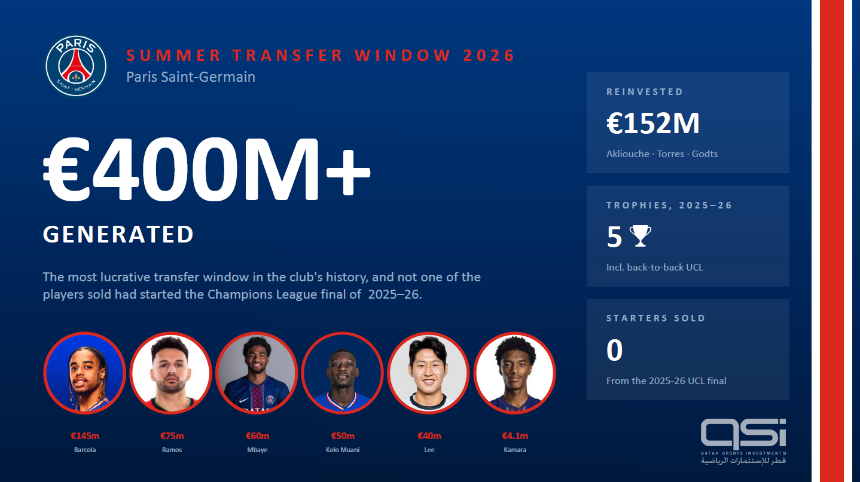
Paris Saint-Germain has closed the 2026 summer transfer window with more than €400 million generated from player departures, marking the highest total in the club’s history and placing the French champions among the most successful European clubs ever in terms of transfer revenue generated during a single window. The figure represents a remarkable evolution in PSG’s approach to the transfer market, particularly given that the club managed to achieve this level of income without sacrificing the core of the squad that has delivered unprecedented success on the pitch. Rather than being forced to part with key first-team players to finance its summer business, Paris Saint-Germain managed to turn squad depth and outgoing transfers into a record-breaking source of revenue while maintaining the competitive strength of its European champions.
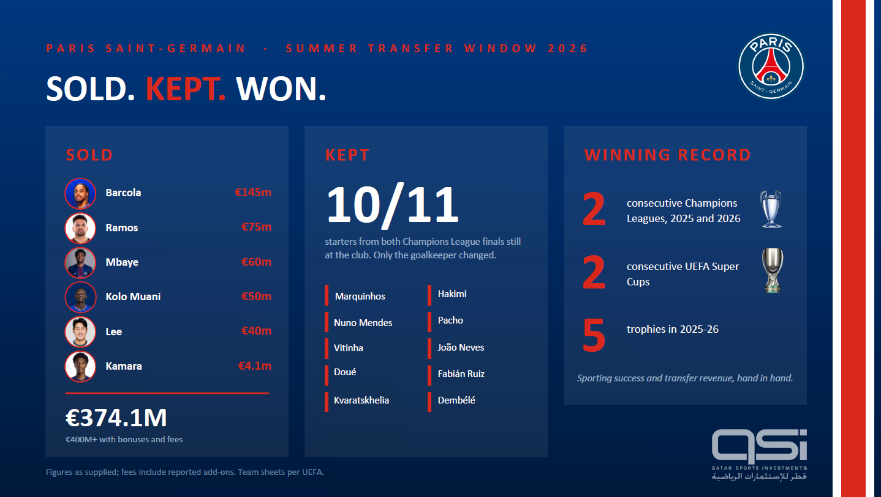
Six players left the club during the summer, yet not one of them had started either of PSG’s last two Champions League finals. That distinction is particularly significant in a transfer market where many of Europe’s biggest clubs have been forced to sell established first-team regulars in order to balance their books or comply with financial requirements. PSG took a different route, allowing players outside its established starting core to leave while protecting the eleven that delivered the club’s historic European triumphs. The result is a transfer window that combines unprecedented financial returns with sporting continuity, reflecting the scale of Paris Saint-Germain’s transformation over the past three seasons. Back-to-back Champions League titles and consecutive UEFA Super Cup victories have been accompanied by a more calculated and commercially intelligent approach to squad management, allowing the club to strengthen its financial position without weakening the team that has established PSG at the summit of European football.
Six departures
|
Player |
Destination |
Fee |
Signed for |
|---|---|---|---|
|
Bradley Barcola |
Liverpool |
€145m |
€45m (2023) |
|
Gonçalo Ramos |
AC Milan |
€75m + €15m in bonuses |
€65m + €10m in bonuses, not reached (2023) |
|
Ibrahim Mbaye |
Aston Villa |
€60m |
Academy graduate |
|
Randal Kolo Muani |
Juventus |
€50m + €8m loan fee (Tottenham) + €6m (Juventus) |
€75m + bonuses (2023) |
|
Lee Kang-in |
Atlético Madrid |
€40m |
€22m (2023) |
|
Noham Kamara |
Lyon |
€4.1m |
Academy graduate |
Fees include reported bonuses and associated payments. Purchase fees as reported at the time of signing.
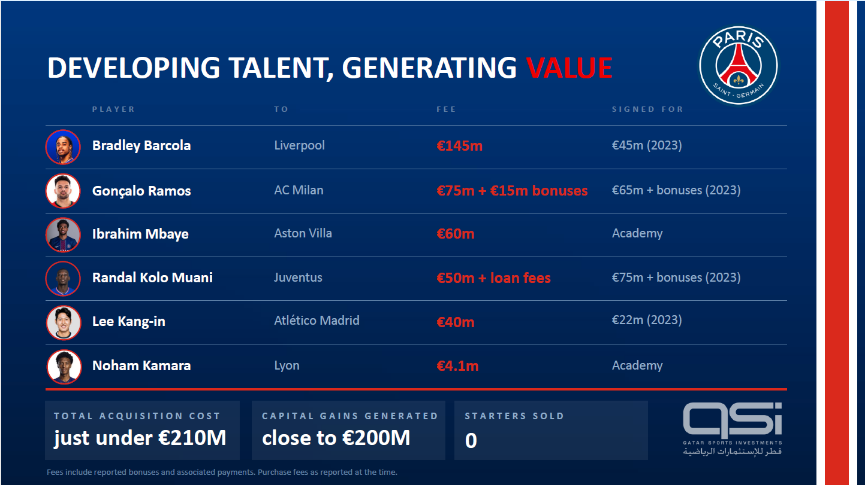
The total initial acquisition cost of the players sold was just under €210 million. Paris Saint-Germain has therefore generated close to €200 million in capital gains within a few years. Squad depth has become an asset in its own right. The club has turned the strength of its bench into a major source of transfer value, on a scale without precedent at this level.
A performance built over time
This summer is not an outlier. Paris Saint-Germain ranks third in Europe for combined revenues from player departures over the last five summer transfer windows, with €788.55 million, behind Chelsea (€1.15 billion) and Manchester City (€845 million). Over the last five seasons combined, the club again ranks third, with €855.6 million, behind Chelsea (€1.20 billion) and Manchester City (€886 million).
During the last ten summer windows, Paris Saint-Germain ranks third with €1.15 billion, behind Chelsea (€1.75 billion) and Manchester City (€1.16 billion). Across the course of the last ten seasons, the club ranks fourth with €1.25 billion, behind Chelsea (€1.97 billion), Benfica (€1.50 billion) and Manchester City (€1.30 billion). These figures illustrate the evolution of the club’s model. One that is now capable not only of attracting talent, but of developing players and creating significant value around their careers in Paris.
Discipline, patience, value
The club’s recent strategy reflects a greater financial discipline and patience in the market: allowing Gianluigi Donnarumma to leave despite widespread scepticism, then winning the Champions League again; waiting six months to sign Khvicha Kvaratskhelia for half the original price; walking away from deals for Zion Suzuki and Yan Diomande when the terms no longer made sense; and bringing Xavi Simons back to the club before selling him for a significant profit.
None of this has come at the expense of sporting ambition. Paris Saint-Germain continues to build a team capable of winning everything while increasing the value of the players within it, demonstrating that sporting success and transfer revenue can go hand in hand, where once they appeared to pull in opposite directions.
Homegrown value, shared success
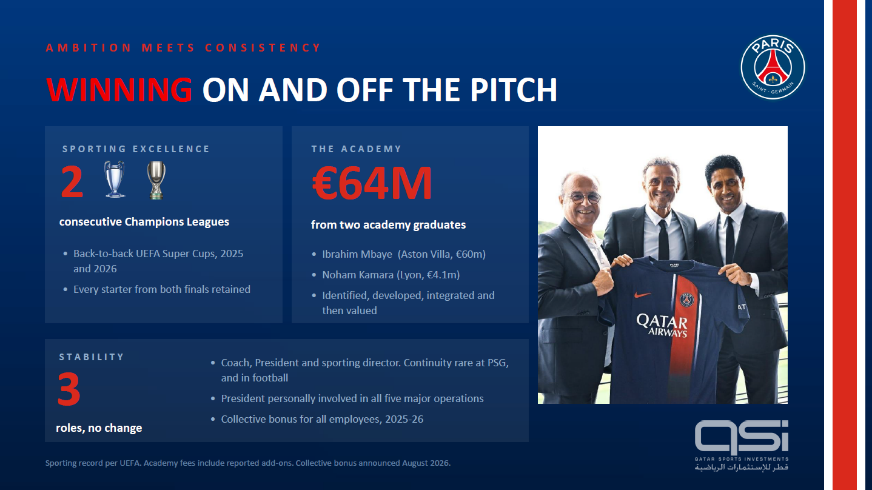
The summer also underlines the role of the club’s Academy. Ibrahim Mbaye and Noham Kamara both came through the youth system: identified, developed and integrated into an ambitious first-team project before generating significant value for the club. The pipeline is now part of the model.
The transformation extends beyond the squad and the balance sheet to the club’s culture. Last week, Paris Saint-Germain announced a collective bonus for all of its employees in recognition of the 2025-26 season. An achievement the club regards as belonging to everyone who works within it.
Just as decisive is continuity. The stability of the coach, the President and the sporting director, rare at Paris Saint-Germain in the past, and even rarer in football today, has been fundamental to the club’s success.
Leadership and vision
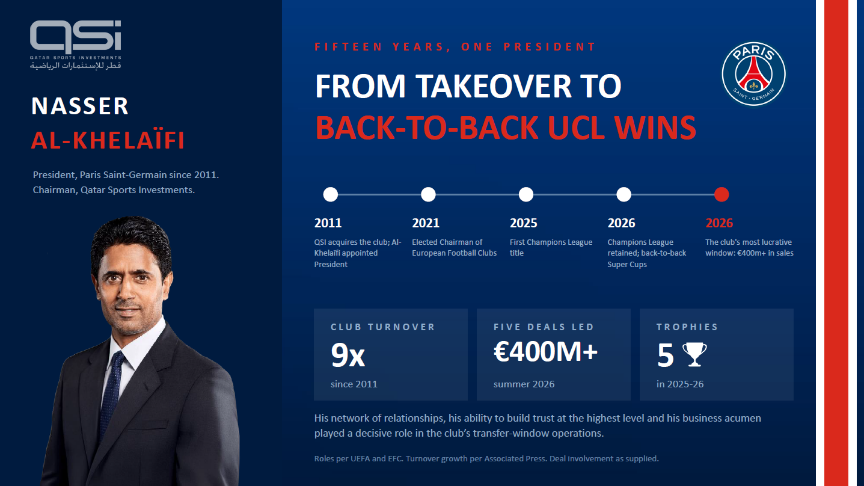
Nasser Al-Khelaïfi, President of Paris Saint-Germain FC and Chairman of Qatar Sports Investments (QSI), was personally involved in all five major operations this summer, negotiating directly at the ownership level with Liverpool, Juventus, AC Milan, Atlético Madrid and Aston Villa. His network of relationships, his ability to build trust at the highest level of the game and his business acumen played a decisive role in the club’s transfer-window operations.
Eight years ago, Paris Saint-Germain was the buyer behind another club’s record summer. This summer, it posted the most lucrative window in its own history. Between those two summers sits the whole story. A club that once bought its ambition now develops it, protects it and, when the moment is right, sells from strength. The eleven who started in Budapest are still in Paris. So is everything they won.

